2024. China’s Vulnerability Paradox: How the World’s Largest Consumer Transformed Global Commodity Markets. New York: Oxford University Press. 312 p.
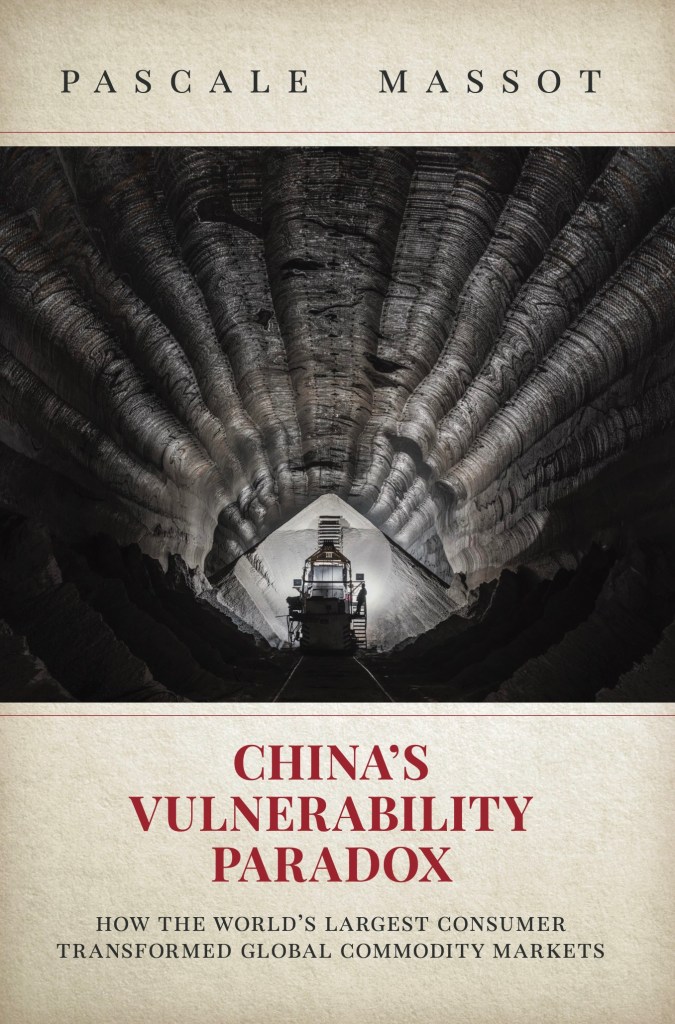
Winner of the 2025 Best book award in International Political Economy from the International Studies Association and the 2025 Peter Katzenstein Book Prize

China’s Vulnerability Paradox explains the uneven transformations in global commodity markets resulting from China’s contemporary, dramatic economic growth. At times, China displays vulnerabilities towards global commodity markets because of unequal positions of market power. Why is it that Chinese stakeholders are often unable to shape markets in their preferred direction? Why have some markets undergone fundamental changes while other similar ones did not? And how can we explain the uneven liberalization dynamics across markets? Through a series of case studies, Pascale Massot argues that the balance of market power between Chinese domestic and international market stakeholders explains their behavior as well as the likelihood of global institutional change. At a time of deepening US-China economic tensions, this book provides an alternative, granular understanding of the interacting dynamics between the political economy of Chinese and global markets.
Endorsements
“Pascale Massot has written a very carefully researched and conceptually innovative analysis of China’s impact on commodity markets. She shows that the Chinese Communist Party’s presence in the domestic economy does not lead to uniformly non-market outcomes. Rather competing interests within China have varying effects on external and internal markets–sometimes these effects are even liberalizing ones. Massot’s deep dive into the heterogenous nature and effects of these internal interests challenges the naive view in much discourse these days that the Communist Party imposes uniform preferences on all actors.” —Alistair Iain Johnston, Harvard University
“Why is China unable to effect desired changes in the global commodity market despite being the largest player? In this thorough and informative book on a topic pertinent to all countries, Pascale Massot unpacks the mix of domestic and international factors behind ‘China’s vulnerability paradox.’ The author delivers valuable insights on the reach and limits of China’s global influence.” —Yuen Yuen Ang, Johns Hopkins University
“A clearly written, comprehensive analysis of one of the key aspects of China’s rise in the last two decades–its enormous impact on the global markets in iron ore, potash, and other commodities. This is an area where the country has risen to number one in a very quick time. Far from this demonstrating hegemonic characteristics, however, Pascale Massot’s book illustrates China as a complex, often contradictory power, within a context in which its newly found dominance is also a source of constant stress and questions. This study sheds light on the nature of global markets, the ways in which China behaves as much in an unplanned as a structured way, the emerging structure of the global economy and the complex interaction between different state and non-state actors within the Chinese economy itself. Almost certain to become the standard work on this issue for the years ahead.” —Kerry Brown, Professor of Chinese Studies and Director, Lau China Institute, King’s College, London
“Avoiding the high-altitude flight path of grand theory, Pascale Massot’s China’s Vulnerability Paradox makes the reader look from the ground up. Her carefully defined concepts take account of much of the variation in political life that others tend to overlook. Simplification, she argues, pays too high a price. She treats conventional binaries — open vs closed markets, domestic vs international political economy, global vs heterogeneous China – with great sophistication and nuance. Insisting on political agency and relationships she points to the importance of unintended consequences. Her book is a welcome call for a dose of humility in our ways of knowing and acting in politics.” —Peter J. Katzenstein, Walter S. Carpenter, Jr. Professor of International Studies, Cornell University
“One of the merits of the book is in the breadth of information that has been brought together in one publication based on extensive field interviews and in the consistent standards that Massot has applied to make the information meaningful for readers concerned with the many issues touching these minerals. Massot is successful in demonstrating some of the practical, theoretical, and policy challenges confronting China’s access to strategic minerals, and deserves a wide readership.” — Claude Comtois, Book Review, Economic Geography
“China’s Vulnerability Paradox is an important addition to the literature covering the nation’s impact, not least its buying power, on the world. It is a recommended source of information forboth general and specialist readers interested in understanding the complexities of China’s economic rise and its role in the international economic system. Furthermore, it builds on Massot’s (2020a, 2020b) earlier works, which I also find insightful. In the academic milieu, the book can be recommended as essential reading for advanced undergraduate, as well as graduate courses in area studies, international political economy, sociology, and related disciplines.” — Guanie Lim, Book Review, The Journal of Development Studies
“A timely, relevant, and well-researched work on one aspect of the economic consequences of China’s emergence.” — Frédéric Lasserre, Book Review, Géopolitiques
Book reviews or excerpts
in The U.S.-China Perception Monitor (Carter Center), by Alice Liu. Power, Vulnerability, and Market Disruption w/ Pascale Massot (https://uscnpm.substack.com/p/power-vulnerability-and-market-disruption?r=3gkgmf&utm_campaign=post&utm_medium=web&triedRedirect=true)
in China File, by Paul French. A Q&A with Pascale Massot about China’s Commodity Markets (https://www.chinafile.com/reporting-opinion/notes-chinafile/chinas-vulnerability-paradox)
in Pekingnology, by Wang Zichen (https://www.pekingnology.com/p/chinas-vulnerability-paradox-how)
in The Page 99 Test (https://page99test.blogspot.com/2024/08/pascale-massots-chinas-vulnerability.html)
in Economic Geography, by Claude Comtois (University of Montreal) (https://www.tandfonline.com/doi/full/10.1080/00130095.2025.2460386?src=exp-la)
in The Journal of Development Studies, by Guanie Lim, National Graduate Institute for Policy Studies (GRIPS), Japan) (https://www.tandfonline.com/doi/full/10.1080/00220388.2025.2484876)
in Pacific Affairs, by Rhys Jenkins (University of East Anglia, Norwich) (https://pacificaffairs.ubc.ca/book-reviews/chinas-vulnerability-paradox-how-the-worlds-largest-consumertransformed-global-commodity-markets-by-pascale-massot/)
Book talks
At the University of Manchester China Institute, September 2024:

Available here:
Oxford University Press: https://global.oup.com/academic/product/chinas-vulnerability-paradox-9780197771402?cc=ca&lang=en&promocode=ASFLYQ6
 Pascale Massot